How to Measure Impact of Schema on Rankings: Guide
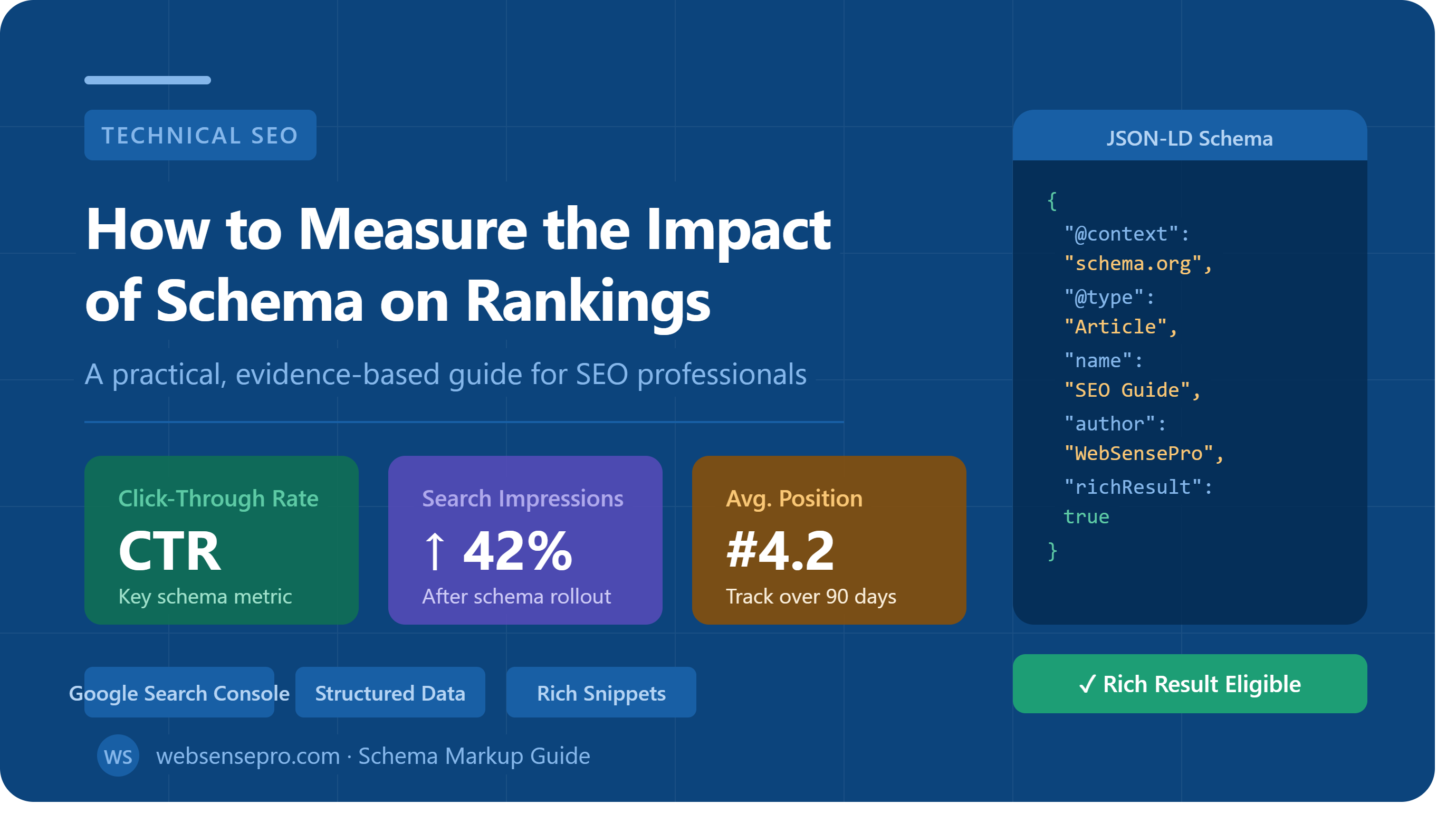
Schema markup is one of the most talked-about topics in technical SEO - and one of the most misunderstood. Many site owners implement structured data expecting an instant ranking boost, then feel confused when their position doesn't change overnight. Understanding how to measure the impact of schema on rankings requires a clear methodology, the right tools, and realistic expectations about what structured data actually does.
This guide provides a practical, evidence-based framework for measuring schema's real effect on your organic search performance.
Does Schema Markup Improve Google Rankings?
Not directly. Google has stated explicitly that structured data is not a traditional ranking signal. Adding JSON-LD to a page will not, by itself, move it from position 8 to position 2.
That said, the indirect impact of schema on search visibility and organic performance is real and measurable:
- It helps Google understand and categorize your content more accurately, which can influence which queries your pages surface for.
- It makes pages eligible for SERP features that increase visual prominence.
- Enhanced listings typically attract a higher click-through rate (CTR), driving more clicks without changing the average position.
- Broader rich result eligibility can expand your total search impressions across related queries.
Knowing how to measure the impact of schema on rankings means looking beyond raw position and tracking the full scope of organic search performance.
How to Measure the Impact of Schema on Rankings
Measuring schema's contribution to SEO performance is a multi-step process. It requires isolating structured data as a variable, monitoring several metrics simultaneously, and accounting for other factors that influence organic search.
Establish a Baseline Before Implementing Schema
Before adding any structured data, record the current performance of the pages you plan to optimize. Without a baseline, you have nothing to compare against.
In Google Search Console, go to the Performance Report and filter by the specific URLs you intend to mark up. For the past 90 days, document:
- Average position for those pages
- Total impressions and clicks by query
- CTR per page and per search query
- Organic traffic from Google Analytics (GA4)
- Which SERP features, if any, do your pages already appear in
Note the exact date of implementation. That date becomes your before-and-after dividing line.
Track Schema Performance in Google Search Console
Google Search Console is your primary measurement tool. After deploying structured data, allow Google at least two to four weeks to recrawl and reprocess your pages before reviewing any data.
Three areas within Search Console are particularly relevant:
- Performance Report: Use the date comparison feature to contrast the 90 days before and after implementation. Filter by URL and examine shifts in impressions, clicks, CTR, and average position.
- Search Appearance Filter: Filter Performance Report results by search appearance type (e.g., FAQ results, product listings) to isolate traffic and impressions generated specifically by rich results.
- Enhancements Panel: This section shows which structured data types Google has detected, how many pages are valid, and how many carry warnings or errors. A growing count of valid rich result pages is a meaningful positive indicator.
Measure CTR, Impressions, Clicks, and Average Position
When reviewing before-and-after data, focus on these four metrics:
- Impressions rising after schema implementation may indicate your content is appearing in more SERP features or for a wider range of related queries.
- CTR improving while average position stays flat is a classic schema signal - rich snippets are making your listings more clickable without a ranking change.
- Clicks growing in absolute terms, controlled for seasonal variation, reflect the engagement benefit of enhanced SERP presentation.
- Average position shifting gradually over time may reflect improved content understanding, though this is harder to attribute directly to schema.
Monitor Rich Results and SERP Visibility
The Google Rich Results Test is the standard tool for validating structured data. It shows how Google reads your JSON-LD and whether your pages meet the eligibility criteria for specific rich result types. Run this test both before and after implementation and any time you update your schema to catch errors early.
Complement validation with manual SERP checks. Search for your target queries and observe whether rich snippets are appearing for your pages. Take screenshots at regular intervals and compare them over time. If you work with an SEO team or consult a platform like WebSensePro, structured data audits and SERP monitoring are typically part of a comprehensive search visibility review.
Compare Schema and Non-Schema Pages
One of the most rigorous measurement approaches is a controlled comparison between similar pages on your site - some with structured data implemented, others left unchanged. For a valid comparison, the pages should be similar in content quality, topic, authority, and age.
After implementing the schema on one group and leaving the other as a control, compare their performance trajectories over 60 to 90 days. Divergence in CTR, impressions, or rich result appearances between the two groups is a meaningful signal attributable to structured data.
How Long Does It Take to Measure Schema Impact?
Set realistic timelines:
- Two to four weeks for Google to recrawl pages and process structured data
- 60 to 90 days for meaningful performance data to accumulate
- Three to six months for reliable trend analysis
Shorter windows often produce misleading conclusions. A spike in impressions in week two may reflect a crawl burst. A CTR dip in week three may be a temporary algorithm fluctuation.
Common Measurement Mistakes
- No baseline: Implementing a schema without documenting pre-implementation metrics makes before-and-after comparison impossible.
- Measuring too soon: Conclusions drawn after one to two weeks are unreliable.
- Ignoring seasonality: Traffic fluctuations tied to seasons or industry cycles can mask or exaggerate schema's contribution.
- Conflating concurrent changes: If you updated content, built backlinks, changed internal linking, or made technical SEO adjustments at the same time, isolating schema's effect becomes very difficult.
- Overlooking algorithm updates: A Google core update during your measurement window can dwarf any schema effect. Cross-reference data swings against known update dates.
- Focusing only on rankings: Because schema's primary impact is on rich result eligibility and CTR - not raw position - ignoring these metrics leads to an incomplete assessment.
Best Practices for Measuring Schema SEO Impact
- Document implementation dates and all concurrent changes in a shared log.
- Annotate your analytics in GA4 at the point of schema deployment so you can visually identify before-and-after periods.
- Wait at least 90 days post-implementation before drawing firm conclusions.
- Check the Enhancements panel regularly for errors - invalid schema will not generate rich results, so implementation quality matters as much as implementation itself.
- Segment by schema type - FAQ schema may show a different CTR lift profile than Product or Article schema. Knowing these differences helps prioritize future structured data work.
- If you manage WordPress sites, tools like Free WordPress MCP can streamline AI-powered content and site management workflows, freeing up time for more strategic SEO measurement and analysis.
Conclusion
Understanding how to measure the impact of schema on rankings means accepting that structured data works through indirect but meaningful channels. It does not flip a ranking switch - but it can expand search visibility, unlock rich snippets that improve CTR, and help Google interpret your content more precisely.
The measurement process requires discipline: set a baseline before you begin, use Google Search Console as your central data source, track CTR, impressions, clicks, and rich result appearances, and give your analysis enough time to be meaningful. Account for algorithm updates, seasonality, and concurrent SEO changes so you are isolating schema's contribution as accurately as possible.
Approached methodically, schema markup is one of the most trackable technical SEO investments you can make - and the data, interpreted carefully, tells a clear story about its value for long-term organic search performance. For a step-by-step walkthrough of this entire process in action, watch this practical video guide that breaks down schema measurement techniques visually.