GEO vs Schema Markup: What's the Difference?
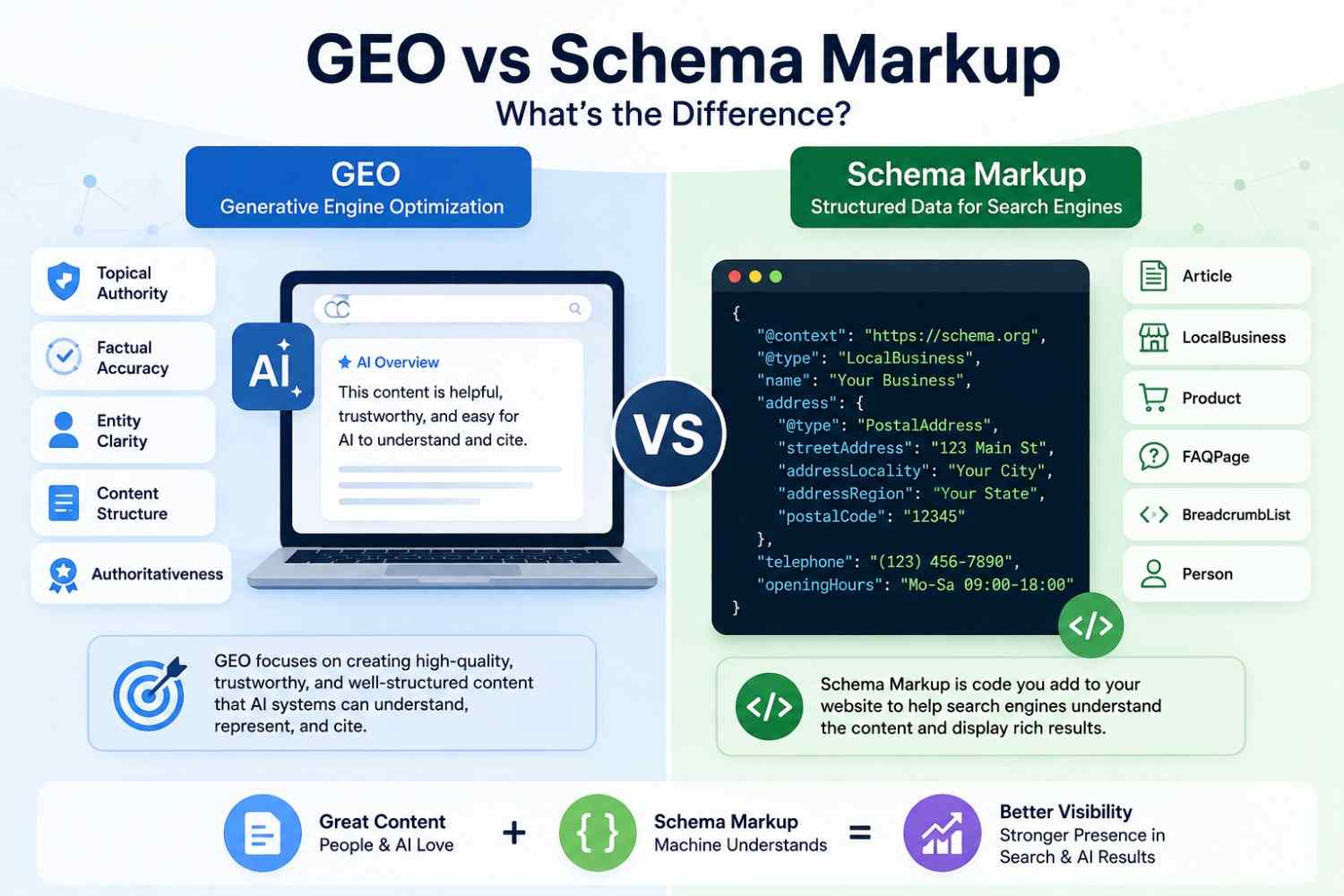
A lot of website owners encounter both terms around the same time — GEO and Schema Markup — and assume they're describing the same thing in different words. They're not. While both relate to helping machines and AI systems better understand your content, they operate at completely different levels. Understanding the distinction helps you make smarter decisions about where to focus your optimization efforts.
What Is GEO?
Generative Engine Optimization (GEO) refers to the practice of optimizing content so it's more useful, trustworthy, and interpretable by AI-powered search experiences. Unlike traditional SEO, which targets algorithmic ranking signals, GEO focuses on making content the kind that generative AI systems can accurately represent, cite, or surface in responses.
That involves a lot more than a technical tweak. GEO typically considers:
- Topical authority — covering a subject with enough depth and consistency that it becomes a credible reference
- Factual accuracy — ensuring information is verifiable and current
- Entity clarity — clearly defining who or what is being discussed, so AI systems can associate content with specific real-world concepts
- Content structure — presenting information in ways that are easy to parse, not just for readers but for machine interpretation
- Authoritativeness — signals that help establish the source as reliable
GEO is not a guaranteed pathway to appearing in AI Overviews, Perplexity answers, or any other generative system. It's an optimization approach aimed at improving the conditions under which that might happen.
What Is Schema Markup?
Schema Markup is structured data added directly to a webpage — typically using JSON-LD format — that provides machine-readable information about what the page represents. It draws from the Schema.org vocabulary, a shared standard supported by Google, Bing, and other major search engines.
Where regular content tells a story, Schema Markup labels the story's components. It might tell a search engine: this page is about a local business; here is its name, address, phone number, and opening hours. Or: this page contains an article, written by this person, published on this date.
Common schema types include:
- Article and BlogPosting
- Organization and LocalBusiness
- Product and Service
- FAQPage
- BreadcrumbList
- Person
When implemented correctly, JSON-LD structured data makes it easier for search engines to understand the entities and relationships on a page. In some cases, it can enable rich results — enhanced SERP features like star ratings, FAQ dropdowns, or event listings — though this depends on the specific schema type and search engine eligibility criteria.
Schema Markup does not directly cause higher rankings. It adds semantic context. Whether or how that context influences visibility depends on many additional factors.
GEO vs Schema Markup: Key Differences
GEO and Schema Markup are often discussed together, but they serve fundamentally different purposes.
GEO is a broad content and strategy-level discipline. It asks: is this content authoritative enough, clear enough, and well-structured enough that an AI system might use or represent it accurately? That question touches everything from how topics are covered to how entities are defined to whether the information is factually reliable.
Schema Markup, by contrast, is a specific technical implementation. It sits in the code of a webpage and tells search engines — in a structured, machine-readable format — what a page is about, who wrote it, what it sells, or how it connects to other entities. It doesn't improve content quality on its own; it labels and clarifies what's already there.
The scope difference is significant. GEO encompasses editorial decisions, content depth, topical coverage, and entity strategy. Schema Markup is one technical component — valuable, but not the whole picture. A site can have perfectly implemented structured data and still lack the topical authority or content quality that GEO requires.
Is Schema Markup Part of GEO?
Schema Markup can be a supporting component within a broader GEO strategy, but the two are not interchangeable. GEO involves the full picture: content quality, topical authority, entity clarity, factual consistency, technical SEO, and structured data. Schema Markup is one technical layer within that.
Think of it this way:
High-quality content + topical authority + entity clarity + factual consistency + structured data + strong technical SEO = a stronger overall optimization foundation
Adding schema to thin or untrustworthy content doesn't constitute GEO. Schema without substance provides limited value. The structured data amplifies what's already there — it doesn't substitute for it.
Can GEO and Schema Markup Work Together?
Yes, and for most established websites, that's the right approach. Here's how they complement each other in practice:
- Create well-structured, authoritative content around topics relevant to your audience
- Clearly define the entities central to your business or subject matter
- Implement accurate Schema Markup that reflects the real content on each page
- Keep business and entity information consistent across your site and external sources
- Build topical coverage by addressing related questions and subtopics in depth
- Keep content updated and factually accurate
- Address technical SEO and crawlability to ensure pages are accessible
When content-level optimization and structured data work together, they create a more coherent signal for search engines and AI systems trying to understand what a site represents. You can use the Schema Markup Validator to confirm your structured data is correctly implemented before indexing.
Which Should You Focus On?
That depends on where the gaps are.
If your site has solid content but little or no structured data, implementing appropriate schema types is a practical next step that can improve machine-readable context without requiring major content changes.
If your site has structured data but lacks useful, authoritative content, the schema is doing limited work. In that case, improving content depth and topical coverage should come first.
For most websites, this isn't an either/or decision. GEO and Schema Markup address different layers of the same goal: making your content easier for both humans and machines to understand and trust.
GEO vs Schema Markup: The Bottom Line
GEO is the broader optimization approach — one that spans content strategy, entity clarity, topical authority, and technical signals. Schema Markup is a specific structured-data implementation that can support machine understanding of your pages.
Neither guarantees AI visibility on its own. Together, they form a stronger technical and editorial foundation for search performance in an environment where generative AI is becoming a significant part of how people find information.
If you're building or refining your structured data strategy, exploring the tools and resources at SEO Schema Markup is a practical place to start.