Aggregate Rating Schema: Best Guide to Winning Rich Results
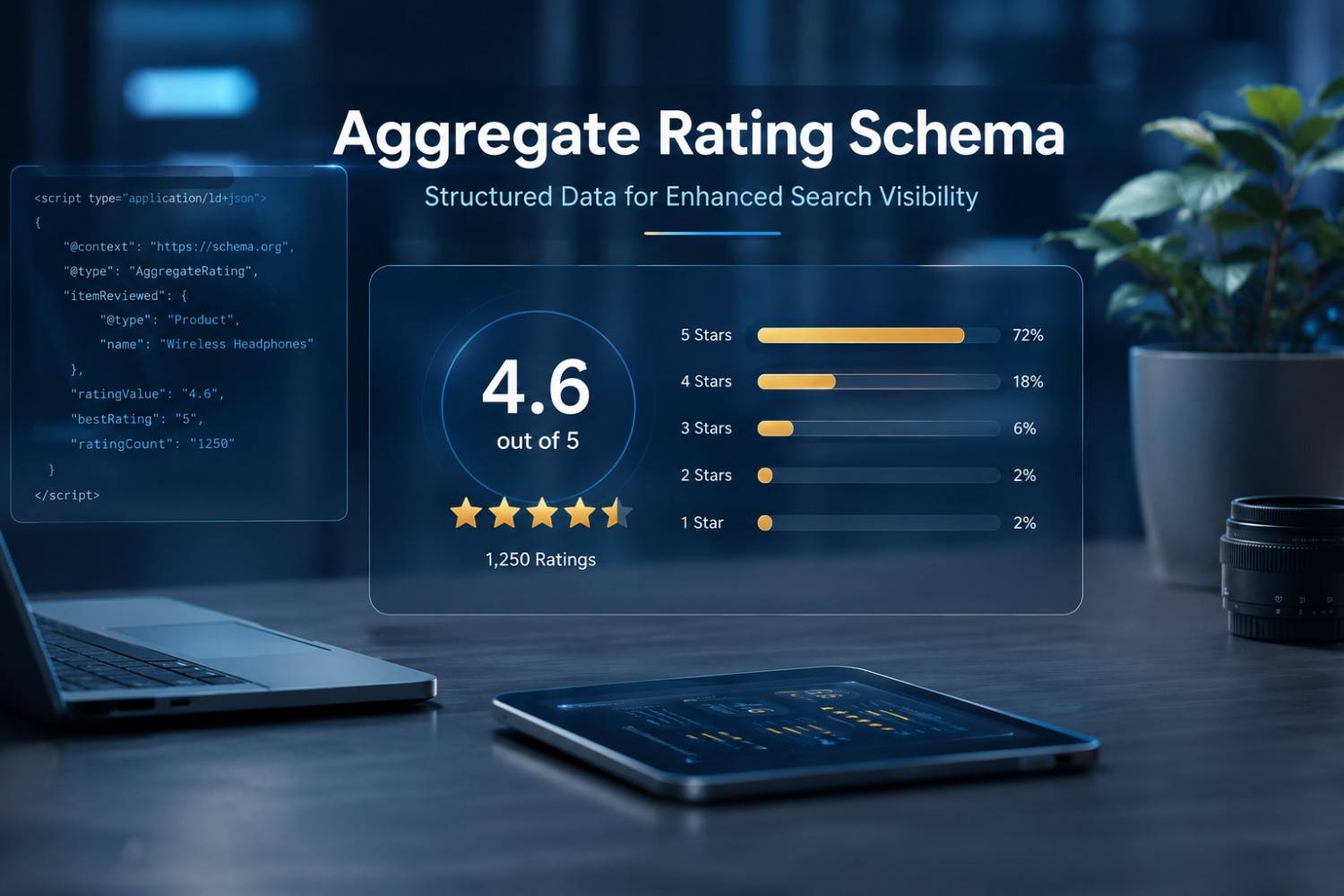
If you've ever wondered why some search results show a row of gold stars while others sit as plain blue links, the answer usually comes down to one small but powerful piece of structured data: Aggregate Rating Schema. It's one of the highest-leverage additions you can make to a page, yet it's also one of the most misunderstood - and misused - types of schema markup on the web.
This guide goes beyond the standard definition. You'll learn exactly how Aggregate Rating Schema works, where it delivers the most value, how it differs from Review Schema, and how to avoid the mistakes that get sites excluded from Rich Results entirely.
What Is Aggregate Rating Schema?
Aggregate Rating Schema is a Schema.org structured data type that summarizes multiple individual ratings or reviews into a single, combined score. Instead of listing every review a product or business has received, it tells search engines: "Here's the average rating, and here's how many people contributed to it."
Did You Know? Aggregate Rating isn't a standalone schema - it's always nested inside another entity, like Product, LocalBusiness, or SoftwareApplication. It never works alone.
Purpose
Aggregate Rating Schema Markup is designed to provide search engines with a structured overview of how users collectively rate a product, service, or business. Google Search doesn't crawl your star-rating widget, and guess what it means — it reads the JSON-LD and understands the exact rating value, scale, and volume of reviews behind it.
How Search Engines Interpret It
When Google's crawlers encounter valid Aggregate Rating structured data, they cross-reference it against the visible content on the page. If the numbers match what a human sees, the page becomes eligible for Rich Results - those star ratings you see beneath search listings. If they don't match, Google typically ignores the markup rather than penalizing the page outright, though repeated violations can trigger manual actions.
Why Aggregate Rating Schema Matters for SEO
Improved Search Appearance
A five-star snippet with "4.8 (2,341 reviews)" visually dominates a search results page compared to a plain title and meta description. This isn't just cosmetic - it changes user behavior.
Better Click-Through Rate (CTR)
Star ratings act as a trust signal before a user ever clicks. Multiple industry CTR studies have shown that listings with visible ratings consistently outperform those without, simply because they reduce perceived risk.
Enhanced Trust
Search Appearance is influenced by real customer reviews, which signal social proof. Shoppers are more likely to trust a product rated 4.6 stars by 500 people than one with no rating at all.
Rich Results Eligibility
Without valid structured data, your page is not eligible for star-rating rich snippets - no matter how good your actual reviews are. Schema is the technical gateway; great reviews are the content behind it.
Quick Takeaway: Rich Results aren't guaranteed by schema alone, but they are impossible without it.
How Aggregate Rating Schema Works
At its core, Aggregate Rating Schema is built from a small set of properties that together describe the shape and scale of a rating.
Rating Value
This is the average score - for example, 4.5. It must reflect a genuine calculated average, not a marketing target.
Review Count
This tells search engines how many reviews contributed to that average. A rating of 5.0 from 2 reviews carries far less weight - and far less credibility with users - than a 4.6 from 800 reviews.
Best Rating
This defines the top of the scale (commonly 5, but sometimes 10 or 100). If omitted, Google typically assumes a 5-point scale.
Worst Rating
This defines the bottom of the scale (usually 1 or 0). Including it removes ambiguity, especially for non-standard scales.
Item Reviewed
This identifies what is being rated - a Product, a Course, a LocalBusiness, an Organization, or a SoftwareApplication. Aggregate Rating is meaningless without a clearly defined subject.
Expert Tip: Always explicitly populate all four numeric properties, even when using default values. Explicit is safer than implicit for structured data validation.
Where Aggregate Rating Schema Can Be Used
Aggregate Rating isn't limited to e-commerce. Schema.org supports it across a wide range of content types:
- Products - the most common use case, showing star ratings under product listings
- Local Business Schema - restaurants, clinics, salons, and service providers displaying customer satisfaction scores
- Software Application Schema - apps and SaaS tools showing user ratings from review platforms or in-app feedback
- Course Schema - online courses and certifications displaying learner satisfaction
- Recipe websites use Aggregate Rating Schema to display the overall ratings submitted by users for individual dishes and cooking recipes.
- Books - publishers and retailers showing reader ratings
- Organizations - companies displaying overall brand trust scores
- Services - professional and local services summarizing client feedback
Content types with high purchase intent - Products, Local Businesses, and Software - benefit most, since ratings directly influence conversion decisions at the point of search.
Aggregate Rating Schema vs Review Schema
These two are frequently confused, but they serve distinct purposes.
| Aspect | Aggregate Rating Schema | Review Schema |
|---|---|---|
| Purpose | Summarizes many ratings into one score | Represents a single, individual review |
| Data Source | Calculated average across all reviews | One reviewer's specific opinion and text |
| Use Cases | Product pages, business listings, apps | Testimonial pages, individual review posts |
| SEO Benefit | Enables star-rating Rich Results | Supports E-E-A-T signals and content depth |
| Typical Properties | ratingValue, reviewCount, bestRating | author, reviewBody, datePublished |
| |
In practice, well-built pages often include both: individual Review entries feeding into a single Aggregate Rating summary.
Common Implementation Mistakes
Even experienced developers introduce errors that quietly disqualify a page from Rich Results:
- Fake or incentivized reviews - Google's guidelines explicitly prohibit self-serving or fabricated ratings.
- Incorrect rating values - a mismatch between markup and visible content is one of the most common causes of manual actions.
- Missing required properties - omitting ratingValue or itemReviewed invalidates the entire block.
- Hidden reviews—marking up reviews that aren't visible to users—violate Google's structured data policies.
- Marking up content users cannot see - this includes reviews gated behind logins without disclosure.
- Invalid structured data syntax - a single misplaced comma in JSON-LD can break the entire schema block.
Each of these can result in silent disqualification from Rich Results, or in more serious cases, a manual action against the domain.
How to Validate Aggregate Rating Schema
Google Rich Results Test
This is the definitive tool for checking whether your Aggregate Rating markup is eligible for star-rating display in Google Search.
Schema Markup Validator
The community-maintained Schema Markup Validator checks technical compliance with Schema.org specifications, independent of any single search engine's rich result eligibility rules.
Manual Inspection Tips
- Compare the JSON-LD values line by line with what's visibly rendered on the page.
- Regularly review Google Search Console to identify and resolve any structured data issues affecting your website.
- Re-validate after every template or CMS update, since automated changes often break nested schema.
Best Practices for Long-Term SEO Success
- Keep ratings accurate and synced automatically with your review database
- Update review counts regularly rather than hardcoding static numbers
- Ensure markup always matches visible page content
- Follow Google's structured data guidelines for review-related schema
- Monitor Google Search Console for structured data errors after deployments
- Use JSON-LD as the preferred format, since it's easiest to maintain and least likely to break page rendering
Myth vs Fact: Myth: Adding Aggregate Rating Schema guarantees star ratings in Google. Fact: It only makes a page eligible - Google still decides case-by-case whether to display rich snippets.
Frequently Asked Questions
1. What is the Aggregate Rating Schema? It's a Schema.org structured data type that summarizes multiple ratings into a single average score, using properties such as ratingValue and reviewCount.
2. Does Aggregate Rating Schema improve SEO? It doesn't directly boost rankings, but it can meaningfully improve CTR and search visibility by enabling star-rating rich snippets.
3. Can the Aggregate Rating Schema help display star ratings in Google search results?
It can make a page eligible for star ratings, but Google ultimately decides whether to display them based on trust signals and content quality.
4. What is the difference between Review Schema and Aggregate Rating Schema? Review Schema represents a single review, while Aggregate Rating Schema summarizes multiple reviews into a single average score.
5. Which pages should use the Aggregate Rating Schema? Product pages, local business listings, software applications, courses, and any page with genuine, verifiable customer feedback.
6. Is Aggregate Rating Schema supported in JSON-LD? Yes - JSON-LD is Google's recommended format for implementing Aggregate Rating and virtually all other structured data types.
7. How do I test the Aggregate Rating Schema? Use the Google Rich Results Test for search eligibility and the Schema Markup Validator for general Schema.org compliance.
8. Can an incorrect Aggregate Rating Schema hurt SEO? Yes. Mismatched or fabricated ratings can lead to lost Rich Results eligibility or, in severe cases, a manual action from Google.